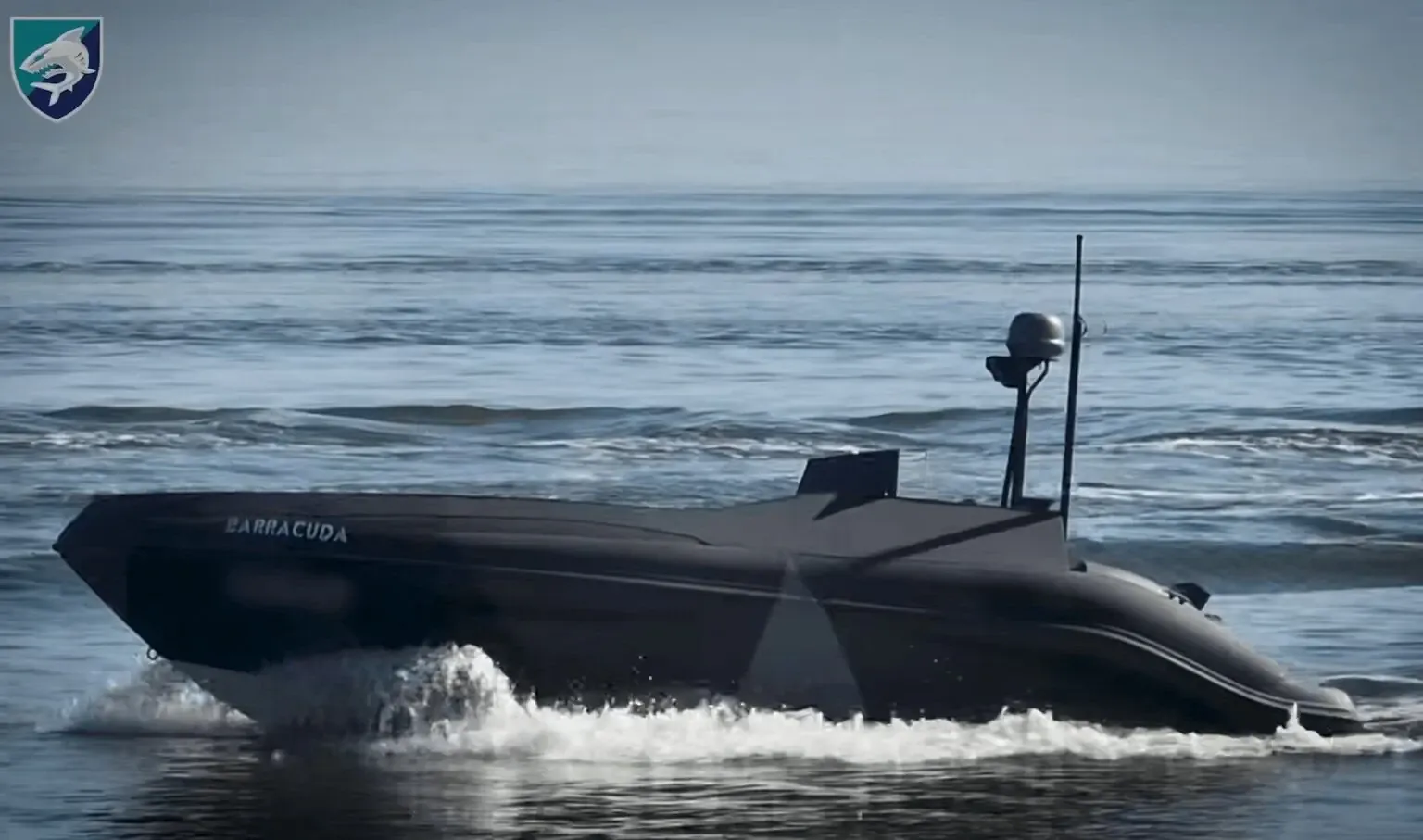
The war in Ukraine shows how fast military innovation develops these days. Where new weapon systems used to take years to become operational, upgrades now follow each other at a rapid pace. One of the clearest examples is the MAGURA family of Ukrainian maritime drones. The latest versions of the MAGURA V5 and V7 mark a new phase: the drone boat is not only armed with air-to-air missiles, but also turns out to function as a launch platform for attack drones. See the video below
From sea attack to air defence
The MAGURA V5 was originally developed as an unmanned attack boat, designed to attack Russian naval ships with a powerful explosive charge. The system proved particularly effective. So far, fourteen Russian ships have reportedly been hit, eight of which were completely destroyed. Among the targets hit were also larger vessels, which forced Russia to pull its Black Sea Fleet further away from the Ukrainian coast.
As its success grew, Russia adapted its tactics. Helicopters were increasingly used to detect and take out the drone boats early, before they could get close to valuable ships. That approach proved effective, but only temporarily.
R-73 missiles change the playing field
Ukraine responded with a striking and bold upgrade. The MAGURA V5 was fitted with two R-73 air-to-air missiles, originally intended for use from fighter jets. These missiles are extremely agile and very suitable for taking out helicopters and low-flying targets.
For the first time, Ukraine’s Main Intelligence Directorate successfully used the MAGURA V5 against air targets. According to Ukrainian sources, two Russian Mi-8 helicopters were destroyed in a recent operation. There are also unconfirmed reports of damage to a Mi-28 attack helicopter. The MAGURA thus changes from a vulnerable target into an active threat to Russian air assets. See the video below.
A new detail: attack drones on board
Recently, a new, less visible but possibly equally important development has been added. Russian soldiers inspected a captured MAGURA drone and discovered that it was fitted with several small attack drones. These drones are not controlled wirelessly, but via fibre optics.
That detail is crucial. Fibre-optic control makes the system almost insensitive to electronic warfare. Jamming and spoofing, means Russia relies on heavily, have no effect on drones controlled via a physical connection. This allows the attack drones to reach their target, even in heavily disrupted electromagnetic environments.
Three innovations in one system
With this configuration, the MAGURA V5 in fact brings together three innovations. First, it remains a fast, hard-to-detect maritime drone that can travel long distances. Second, the vessel now acts as a launch platform for separate attack drones, greatly increasing range and flexibility. And third, fibre-optic control ensures these drones can hardly be stopped with conventional electronic countermeasures.
This means the MAGURA no longer carries out just one attack, but can create several threats from different directions and domains. Naval, air and electronic warfare increasingly merge into one another.

Image: The Associated Press.
Technical capabilities and use
The MAGURA V5 can sail at high speed and travel hundreds of kilometres, depending on mission profile and load. Its low radar and heat signature makes detection difficult, especially at night or in rough weather. On board are cameras, navigation systems and communications equipment that allow operators to steer the mission precisely.
The addition of missiles and attack drones also changes the tactics. Russian helicopters can no longer operate low over the sea with impunity, while ships have to reckon with attacks that no longer come only from the water surface.
Rapid innovation as a strategic advantage
The continuous development of the MAGURA V5 underlines a broader trend in this war: rapid innovation has become a weapon in itself. Feedback from the front leads within weeks to adjustments, new configurations and unexpected combinations of existing technology.
What began as a relatively simple kamikaze boat has grown into a multi-purpose drone system that poses a serious challenge to a traditional navy. The MAGURA V5 shows that naval warfare is changing drastically — and that unmanned systems are playing an ever more dominant role in it.