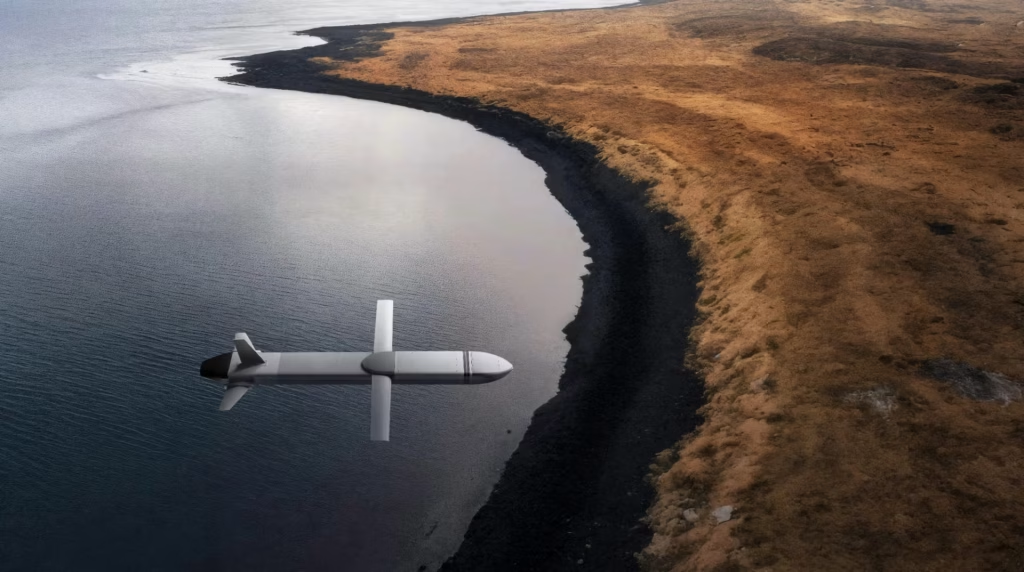
Destinus has released new details about an updated version of its cruise missile: the Ruta Block 2. It is a weapon explicitly designed for medium-range strikes at the front and fits the lessons the war in Ukraine has exposed in recent years. Not only the highest technical perfection counts, but also availability, scalability and cost-effectiveness.
The Ruta Block 2 is an autonomous cruise missile intended for engaging high-value stationary targets. Think of fortified positions, infrastructure, command posts, concrete structures and concentrated troops. The missile is launched from a launch tube with the help of a booster, after which it continues its flight at low altitude. That low flight profile reduces the chance of detection and makes interception by enemy air defence more difficult.
During flight, the Ruta uses AI-driven multi-mode guidance. This means the system combines several navigation and sensor methods and can switch constantly when one of those systems is disrupted. In combination with built-in anti-jamming measures, the missile remains usable in environments where electronic warfare is used. According to Destinus, this makes the Ruta suitable for use in areas with layered air defence, a scenario that is becoming ever more realistic in modern conflicts.

Image: Destinus
With a range of more than 450 kilometres and a payload of 250 kilograms, the Ruta Block 2 clearly sits in the segment of medium-range weapons. The system is designed for use from self-propelled or mobile missile launchers and is compatible with allied launch installations and command systems, including C2 and AI swarm networks. That makes integration within NATO structures relatively straightforward.
It is important that Destinus has explicitly designed the Ruta for large-scale production. The weapon is not built according to the classic model of expensive, extremely sophisticated cruise missiles of which only small numbers are available. Instead, the focus is on simplicity, reliability and series production. That matches what the war in Ukraine has shown: precision weapons remain essential, but without sufficient numbers they lose their strategic value. Mass and quality are no longer opposites, but must come together.
That reality aligns remarkably well with statements by State Secretary for Defence Gijs Tuinman. He recently indicated that the Netherlands needs its own long-range precision weapon, comparable to a Tomahawk, but not necessarily with the same high requirements and associated costs. According to Tuinman, the Netherlands must learn from Ukraine, where it turns out that affordable weapons that can be produced quickly and in large numbers are at least as important as high-end systems. The ideal is to have both, but practice demands choices.
In that light, Destinus suddenly becomes a very relevant player for the Netherlands. The company is already supplying missiles to Ukraine, where they are actually being used operationally. The Ruta Block 2 is a further development and improvement of earlier systems. This means it is not a concept or a future design, but technology that comes from operational experience.
Moreover, Destinus has long ceased to be a small start-up. The company is active in several European countries and is expanding its industrial presence. In the Netherlands, Destinus produces at VDL, where more and more defence-related companies are establishing themselves, such as Milrem Robotics and DeltaQuad. This creates an industrial cluster that can not only develop, but also actually build and scale up. That is exactly the capacity the Netherlands is looking for to become strategically less dependent on foreign suppliers.
Although Destinus is still relatively unknown to the general public, the combination of investments, operational deliveries and new weapon systems shows that the company holds a serious position within the European defence industry. The Ruta Block 2 underlines that picture. It is a weapon that fits today’s military reality: quick to deploy, hard to intercept, suitable for mass production and tailored to modern warfare in which electronic interference and air defence play a central role.
See also Destinus’s further plans.


