
At the defence fair in Rotterdam this week, one feeling was above all tangible: urgency. A Dutch precision weapon. The Netherlands wants to strengthen its defence industry and no longer be dependent on foreign suppliers of missiles and drones. State Secretary Gijs Tuinman stressed that the Netherlands urgently needs long-range precision weapons and that they should preferably be produced in the Netherlands. According to him, it should even be possible to develop a Dutch precision weapon within six months, especially if Dutch companies join forces. That raises the question: who can build a Dutch Tomahawk-like missile in such a short time? Gijs Tuinman does indicate that it does not have to meet the high requirements of such a missile, since that has of course been in development for years. But it must still be possible to develop a good missile with a shorter flight time. It is now about mass and no longer about the very highest quality.
The question is who will then make this missile in the Netherlands. Among the well-known European defence companies, one name unexpectedly pops up: Destinus. This European aerospace company, officially based in Switzerland but active in several countries including the Netherlands, is making a quiet but striking advance. Where Destinus was initially known for futuristic hypersonic aircraft concepts, the company turns out in reality to be much further along with operational missile technology.
What has hardly been noticed outside the industry is that Destinus has long ceased to be a start-up. The company actually produces missiles for Ukraine, and they are used there in operational conditions. That suddenly makes Destinus relevant in the Dutch debate on domestic missile production. Companies that are already producing and scaling up have a huge head start on newcomers still in the design phase.
The most striking weapon in its portfolio is the Destinus Ruta, a hybrid between drone and missile. The Ruta combines the range and impact of a missile with the agility of a drone, making it harder to intercept. The Ruta flies fast, can be deployed flexibly and is relatively cheap to produce. Such systems are very attractive for countries looking for affordable long-range weapons, as the Netherlands is now doing.

(Photo Destinus)
Also striking is the Destinus Heer, a small unmanned aircraft that according to the company’s own website is suitable for kamikaze attacks and jamming operations. That a European defence company communicates so openly that a system is intended for kamikaze tasks underlines how directly Destinus responds to the reality of contemporary warfare. Such light, flexible weapons play an increasingly important role in modern conflicts and fit seamlessly with the growing demand for short- and medium-range precision weapons.
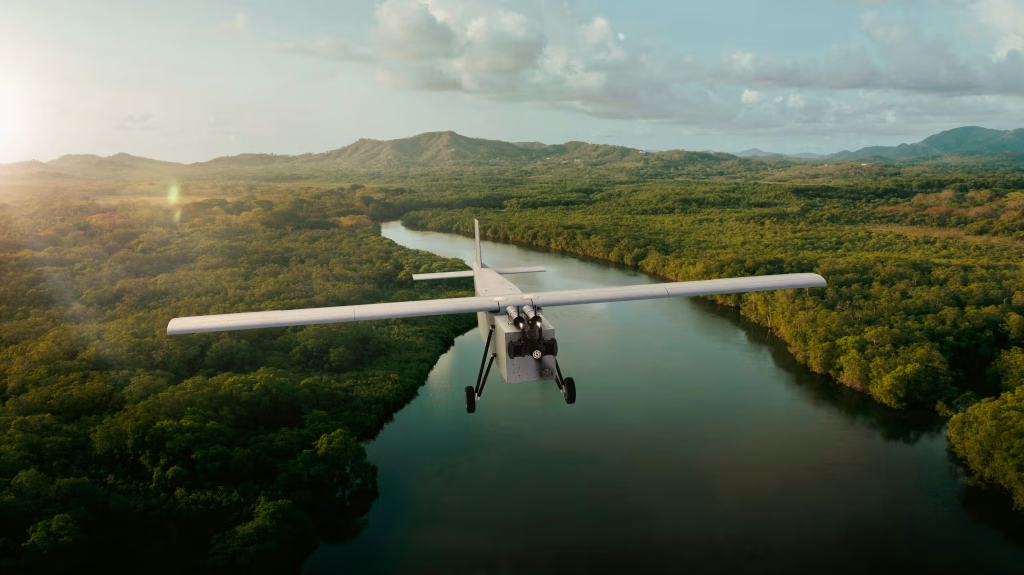
(Photo Destinus)
It is precisely the combination of innovative designs, existing production lines and a presence in the Netherlands that makes Destinus a possible candidate for the plan Tuinman outlined. A company that already produces missiles within Europe, has experience supplying a country at war and is working on cheap, scalable systems fits remarkably well into the picture of what the Netherlands is looking for: its own missiles, quick to produce and based on modern technology.
Whether Destinus will actually play the role now being cautiously suggested is still unclear. The state secretary did not mention any names at the fair. But one thing seems certain: if the Netherlands seriously wants to invest in its own long-range missile that can be developed within six months, the list will not be very long. And the name Destinus is on that short list.
Europe is in the middle of a technological catch-up, and the future of Dutch missile building could well be written by a company that until now has largely flown under the radar.


