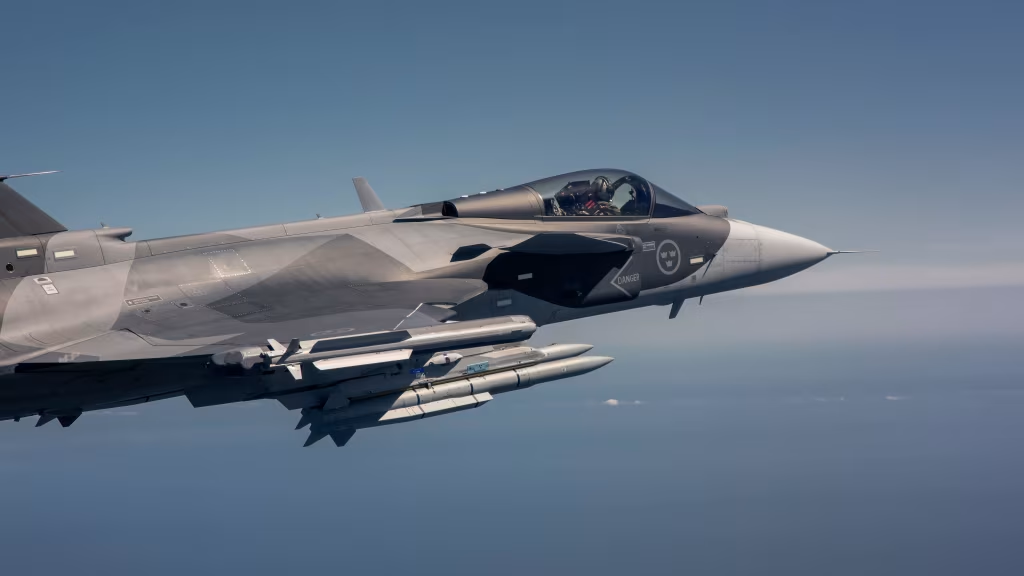
While Europe talks mainly about the F-35 and upcoming sixth-generation fighters, one aircraft is gradually claiming more and more attention: the Saab Gripen E. Not a stealth aircraft, no gigantic price tags, but a smart combination of speed, sensors and a missile that changes air combat. Ukraine is getting 150 of these fighter jets
At a time when air forces face rising costs, greater threats and a shortage of aircraft, another story is gaining ground: that of efficiency. And that is exactly where the Gripen E shines.
Compact, fast and built for modern warfare
The Gripen E was designed with one core idea: maximum efficiency. The aircraft is smaller, lighter and more agile than most modern fighters, yet offers technology that lets it compete with the big players.
With a top speed of Mach 2 (about 2,450 km/h) and the powerful GE F414G engine — the same engine family as in the F/A-18 Super Hornet — the aircraft has impressive performance. A fast climb, sharp manoeuvres and stable behaviour at high speed make it particularly suitable for air combat in which seconds make the difference. And of course stealth aircraft have an advantage: they are seen less quickly on radar, and that is a big advantage. But we do see that only a few countries have stealth aircraft. Russia still uses them only sparingly in the war in Ukraine, and China has them but they are not yet as advanced as America’s. A potential enemy of Sweden therefore has no or few stealth aircraft. That is why the Gripen E is an aircraft to be taken seriously.
Source: Saab Brazil, the Gripen E fires a Meteor missile.
Although the Gripen E is not a stealth aircraft, Saab has done a lot to reduce its radar visibility. Through subtle shaping, radar-absorbent materials and reducing reflective surfaces, the aircraft is harder to detect than older generations of fighters. Not complete invisibility, but a clear advantage when it counts.
A sensor suite that sees you before you see it
Where the Gripen E really impresses is the combination of radar, sensors and electronic warfare. The aircraft uses a modern AESA radar that can track several targets at once at long range. In addition there is an IRST system, which works passively: it emits nothing. This allows the Gripen to detect an enemy without giving itself away.
Especially against stealth aircraft this offers a surprising opportunity. Stealth works well against radar, but not against infrared. A good IRST system can perceive heat differences from a great distance — an advantage the Gripen exploits.
Together, these sensors form the heart of the Gripen’s strategy: see first, shoot first.
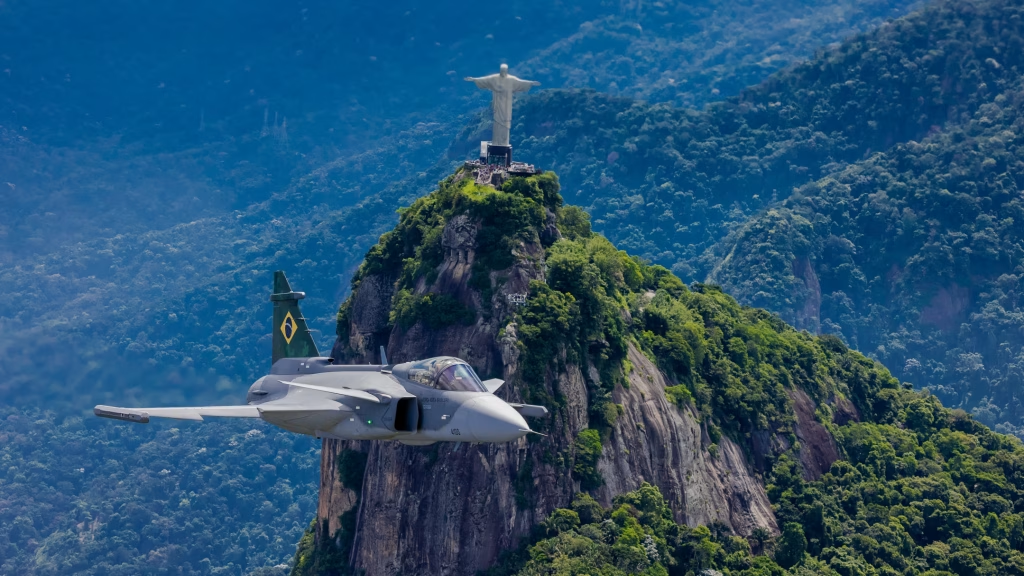
Image: Saab.
Meteor: the missile that rewrites the rules
The real strength of the Gripen E only shows, however, with the MBDA Meteor, a long-range missile that redefines air combat. With a length of 3.65 metres, a weight of 190 kilos and a top speed of Mach 4 (about 5,000 km/h), the Meteor is one of the most dangerous air-to-air weapons in the world.
The secret is the ramjet engine. Where traditional missiles burn their energy in one go and then slow down, the Meteor’s ramjet keeps drawing in and burning air. That means:
- the missile keeps accelerating, even at long range
- it keeps its speed until the end
- it can manoeuvre longer than other missiles
Even at 150 to possibly 200 kilometres away, the missile remains agile enough to hit a target trying to escape. That is unique — and exactly why experts call the Meteor a “game changer”.
When you combine that Meteor with the Gripen E’s sensors, you get an aircraft that can be deadlier at long range than many stealth aircraft.
Saab (the supplier of the Gripen E) also makes large radar aircraft. These have also already been delivered to Ukraine. These radar aircraft can see much further and therefore locate stealth aircraft earlier. Saab is also working on stealth drones that may be linked to the Gripen E. So Sweden too is thinking about the future; it is just choosing a different route.
An alternative for countries that do not want only stealth
The Gripen E is popular because it offers a different route to air superiority. Not everyone has a budget like the US or China. Many countries want high-end capabilities, but without a multi-billion campaign.
So far, Sweden, Brazil, Colombia and Thailand have together ordered 117 Gripen E aircraft — a fine number for a non-stealth aircraft and a small country. The lower operating costs are an important reason: at a fraction of the cost per flight hour, an air force can train more hours and keep more aircraft operational.
For smaller air forces that is crucial. An aircraft that performs 20% less, but is always available and remains widely usable, can in practice be stronger than a very expensive aircraft that can only fly to a limited extent.
Why experts say the Gripen deserves a role
Air force analysts and defence specialists increasingly stress that the Gripen E is a strategically valuable alternative. Not because it can replace the F-35, but because it offers something different:
- an aircraft that specialises in long-range air combat
- with a missile that can keep stealth aircraft at a distance
- that is cheap enough to fly a lot
- and reliable enough to be available in large numbers
For countries that want to strengthen their air force but do not want to depend completely on stealth technology or American deliveries, the Gripen E is a logical and sometimes even necessary choice.
Conclusion: the Gripen E is no underdog — but a smart strategy
In a world where stealth often dominates the conversation, the Gripen E proves something else: that technology, speed and long-range missiles form an alternative path to air superiority.
The aircraft is not a ghost like the F-35, but it does not need to be. The Gripen E is a calculated answer to modern air threats — compact, efficient, affordable and armed with one of the best missiles ever built.


