
In an open field near Victorville, California, a striking unmanned aircraft took off at the end of October 2025: the YFQ-44A, a new jet-powered drone that is turning the world of military aviation upside down. What stands out immediately about this aircraft is that it is not just a reconnaissance drone. It is designed to fly alongside manned fighter jets, share information and tackle threats autonomously. This test flight marks an important milestone in the CCA programme, in which the Netherlands also takes part, and that makes it extra interesting for the Dutch defence industry. Could this be the drone that will work with the Dutch F-35?
The YFQ-44A is part of the American Collaborative Combat Aircraft (CCA) programme. Where traditional drones are mainly used for observation or controlled strikes at a distance, this drone is a real “loyal wingman”: an autonomous partner that relieves the pilot, provides tactical information and, in a future phase, can even intervene on the battlefield on its own. According to experts, this could fundamentally change the concept of air operations. See below a video of the YFQ-44 drone carrying out a test flight.
During the first test flight, the YFQ-44A carried out a fully semi-autonomous mission. The aircraft took off, flew a pre-planned profile and returned on its own for a safe landing. No direct control by a pilot was needed; human operators only supervised. This illustrates how advanced the software and autonomous systems are. Anduril Industries, the developer, stressed that autonomy was central to the design from the start. It was not a later addition, but a core function of the drone, which makes the flight all the more significant.
Technically, the YFQ-44A combines speed, agility and intelligence. It is jet-powered, which allows it to keep up with manned fighter jets in air combat. At the same time it can gather and share sensor data with other aircraft, carry out electronic warfare, classify threats or even act as a decoy to draw the attention of hostile systems. The aircraft is modular and flexible; it can be used in different ways depending on the mission.
According to air force experts, a network of drones such as the YFQ-44A can make the difference in modern conflicts, where speed and information transfer are crucial. Pilots can concentrate on strategic decisions, while drones carry out autonomous tasks that used to be risky or repetitive. At a time when enemy drones, missiles and electronic threats are fast and complex, this technology offers an important tactical edge.
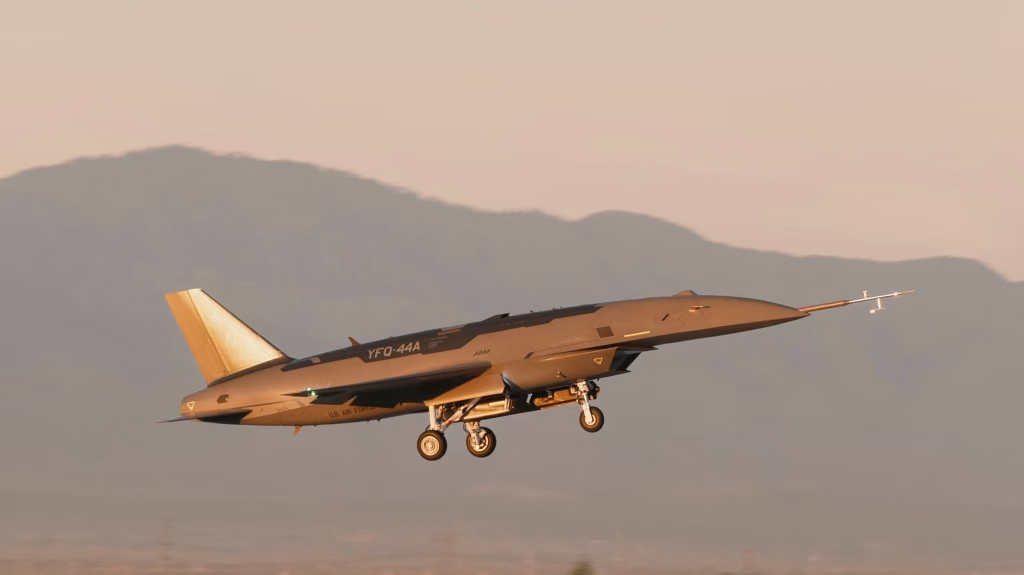
Image Anduril: the YFQ-44A drone being tested.
The Netherlands’ involvement in the CCA programme is interesting. Although the project is primarily American, the Netherlands provides input on interoperability, software integration and tactical concepts. This allows the Royal Netherlands Air Force to gain experience with autonomous platforms and help think about the use of such systems in a European context. For the Dutch defence industry, this means our companies can benefit from the development of advanced technologies and enter into international partnerships at the highest level.
What makes the YFQ-44A extra fascinating is the combination of autonomy and cooperation. The aircraft can make decisions on its own about flight paths and priorities, but remains fully integrated into the team of manned aircraft. Experts describe this as “human-on-the-loop” rather than “in-the-loop”: human operators supervise, but do not have to give every command. That speeds up the response to threats and makes operations much safer and more efficient.
The first test flight is only the beginning. The CCA programme ultimately aims for a fleet of hundreds of such drones, able to operate in coordination with manned aircraft. This concept of mass autonomy could drastically change air combat in the future. For the Netherlands, participation means the country is not just watching, but actively helping to build the next-generation air force.
The YFQ-44A shows that autonomous drones are doing more and more than just reconnaissance or strikes at a distance: they are becoming a full partner in the air. For the Netherlands and other allies, it is important to follow technologies like this closely. It offers insight into the future possibilities of air operations, gives the Dutch defence industry opportunities for international cooperation and sets a new standard for how modern warfare can unfold.
With this test flight, the YFQ-44A has become a concrete example of a technology that once seemed futuristic, but is now tangible. It shows that autonomous, collaborative aerial platforms may play a central role in the coming years, and that the Netherlands is actively involved. For military personnel, policymakers and technology developers, this is a development to watch closely.


