
In 2026 the Dutch navy enters a new reality. (The support vessels) A reality in which not only large frigates determine firepower, but in which smart, compact support vessels form an essential part of maritime deterrence. The two new vessels Damen will build look modest at first glance, but appearances are deceptive. They are designed to deliver exactly what the Netherlands has lacked for the past twenty years: striking power.
The new support vessels.
After Afghanistan and Iraq, the idea prevailed that the Netherlands mainly carried out peace operations. The seas were relatively calm, the threat manageable. But that era is over. At the edges of Europe the geopolitical landscape is grinding, and on the North Sea the MIVD now sees concrete indications of espionage and preparations for sabotage. Drones, hypersonic threats and cyber attacks have drastically changed the maritime arena. The world has become harsher — and the Netherlands is waking up.
In that new world, these ships are exactly where they belong. They will carry containers with air defence, long-range precision munitions and electronic warfare equipment. So not a heavy frigate, but a flexible platform that can be converted in a short time from munitions carrier to sensor ship. It is the kind of thinking that suits modern navies, in which you do not cram everything into one ship, but spread firepower over several affordable platforms.
The idea of the “missile ship” — a smaller vessel carrying a large number of weapon systems — has been on the rise for years. Not in Europe, but mainly among great powers preparing for combat at sea. China has probably gone furthest. Its forces have swarms of Type 022 missile boats and are working on several classes of unmanned or lightly crewed platforms packed with long-range missiles. They are cheap, quick to build and extremely suitable for saturation attacks: the tactic of overwhelming the enemy with so many missiles that no defence system can intercept them all.
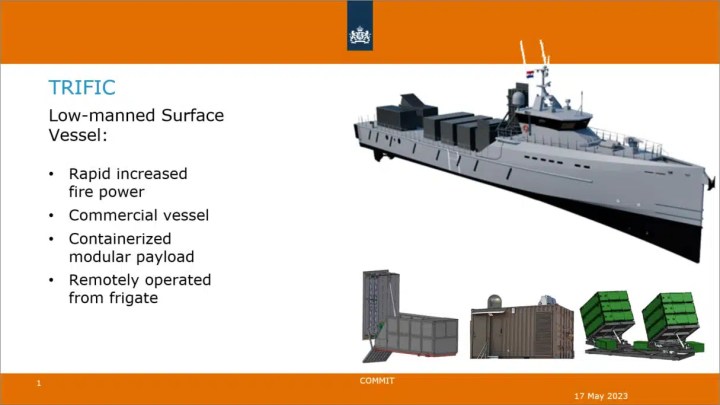
Photo Commit
Other countries are working on it too
The United States is also working on a variant of that concept. In the LUSV programme (Large Unmanned Surface Vessel), the US Navy is experimenting with large drone ships that carry almost nothing but missiles and are controlled by manned ships. The goal is clear: spread the missiles, increase firepower and reduce risks. If a large frigate is hit, you lose a billion-dollar platform. If a cheaper missile ship is deployed, you drastically limit that risk. Russia, albeit less modern, is working on similar ideas with light missile boats in the Black Sea and the Caspian Sea.
That the Netherlands is now also going in that direction is therefore less of a remarkable choice than it seems; it is a signal that The Hague understands the technological trend and is finally investing in maritime striking power that suits these times.
What is particularly interesting is the way the new Dutch ships function. They sail close to the air defence frigates and are directly controlled by these frigates. The frigate decides, the support ships execute. The missiles on board — extra anti-air missiles against drones and anti-ship attacks, but also precision missiles for land targets — become, as it were, an extension of the existing frigates. You suddenly double the firepower of one ship, without actually having to build a second frigate.
This creates a new tactical layer. The support ships do not become targets in themselves, but carriers of firepower — and that firepower can be divided, dispersed and moved without making the whole fleet more vulnerable. It is exactly the philosophy the navies of China and the US are now applying: you win not only by being big, but by stacking smartly.
Not just a missile ship
Yet it is not only about missiles. The North Sea today is a battlefield that has not yet heard any shots, but is full of risks. Wind farms, pipelines, data cables, drilling platforms — it is infrastructure that forms the foundation of the Dutch economy. Intelligence points to attempts at espionage, underwater reconnaissance and possible sabotage. The new naval ships therefore bring another crucial capability: underwater drones and sensors to detect suspicious activity. Together with electronic warfare, which blinds enemy radars and jams drones, this creates a network of detection and protection the Netherlands has never had at sea before.
All this comes together in ships that are smaller than frigates, but whose impact is much greater than their physical size suggests. They are not meant to operate alone, but as a force multiplier for the entire fleet. They carry missiles that would otherwise not fit on frigates, guard the North Sea, support marines in amphibious operations and can be deployed flexibly on missions that previously required large platforms.
It is a rare combination of pragmatism and innovation. The ships cost a fraction of a traditional warship, but add a capability the Netherlands urgently needs. “Striking power”, soldiers say more and more often. Not as an aggressive ambition, but as a sober observation: without firepower you cannot defend what you hold dear these days.
And perhaps that is the most striking thing about these new vessels. They mark the moment the Netherlands finally faces the fact that the world is no longer automatically safe. That protection is not only about diplomacy and patrols, but about concrete means that deter, defend and, if it really has to, can strike back hard. The navy will first test with these ships. And there is a possibility that more may be acquired.
In the following articles we will take a closer look at the missile systems that will be placed on these ships.


